Archives for the month of: March, 2011


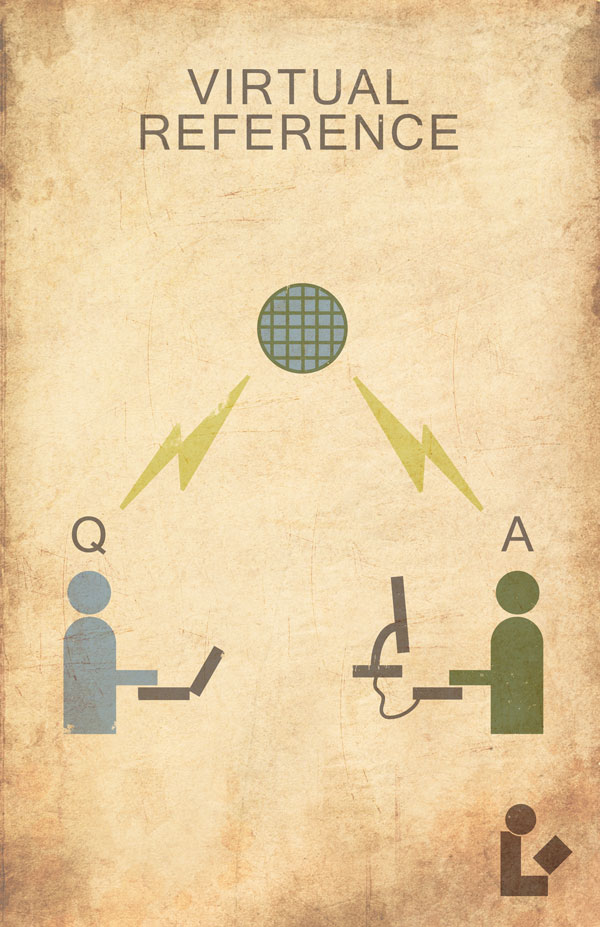
Another entry in the Library Minimalism category: Virtual Reference.

Though, I suppose if an actual poster looked this rough and was hanging in your library, you’d want to replace it. Or, more likely you’d want watch out for wandering hordes of mutants.

I swear I’ll get back to regular posts soon, but these minimalist pictures are just so much darn fun.

Circulation!
I was in a meeting about MODS and XML (A schmancy new digital cataloguing methodology – dry conversation, but useful stuff.). Something clicked, and I had the inspiration for a few more Library Minimalism pictures. 

I should scan the page. Anyone who knows me from library school at Western probably knows I take unique notes. Heh, not that I wasn’t paying attention. Also, Science supports the habit.

“Circulation” is the first of the two, or maybe three, that will come out of that meeting.

I’m also working on setting up a web-store. Soon, you’ll be able to buy Library Minimalism posters and other Drop the Reference Bomb swag. Nice, right?


A great, educational video via PrivitizationBeast.org, a web-based rallying cry to stop corporate takeovers of libraries.

Here’s a snippet from a recent blog post:

Last year, Santa Clarita’s City Council rammed through a vote to privatize their library system with very little community input. Community members were understandably outraged, and attended several public hearings requesting more community involvement in the decision-making process. Instead of listening to residents, the City Council created a “Citizen’s Advisory Committee” to review Santa Clarita’s library system and its needs and make recommendations for moving forward with LSSI. The committee had no decision-making power, and was widely criticized as a thinly veiled attempt to silence critics.

Oh, but it gets better. The City Council invited LSSI executive Ron Dubberly to chairor, technically, ‘facilitate’ this committee. In other words, the committee created to advise on the city’s relationship with a private company is being controlled by that same private company. Dubberly has been President of LSSI’s Public Library Management Operations since 2008.[full post]

That’s madness and a little perturbing. Privatisation is not the best idea. There is no guarantee that privatising something will save costs. For example, last year the Ottawa city garbage workers were able to take away the trash at a cost lower than the lowest private-sector bid.

But, I don’t know if I totally agree with the slippery slope they lay out in the video. Used bookstores and cafés are not so onerous. In the case of cafés, there is an opportunity to build a locally focused business with a strong ethical aspects, such as a commitment  fair trade coffee, compostable cups, etc. Also, no one really is against paying for photocopies, a long standing revenue stream used to offset the cost of the photocopying service. Read the rest of this entry »

Library SoundTrack Fridays is back with a twee-ish mix. Spring is almost here, but in Ottawa it’s not that near.  I’ve got some picks to help soften the first bitter tastes of a cold March.

From LA, we get Family of the Year. These kids take good ol’fashioned indie rock, sprinkle it with a dash of America (whom I very guiltily love), and then throw on a layer of twee icing. Something they do makes me want to go check my camping gear (but it’s way too early).

this week, I rediscovered Snailhouse‘s Lies on the Prize (long listed for the 2009 Polaris prize). It’s one in the win column for songs that make me wish I could sing out-loud at work.

And, since we started with some newer twee indie pop, I’ll end with one of my perenial favourites. Yep, just like most people, I like Belle and Sebastian.

They’re great for dreary days or whenever, really. Sing along. In your chair. In your head. At the bus stop. Wherever. 

Take heart! Have a great weekend!

Crafty Space Invaders

The fervour stirred up by the HarperCollins eBook policy is pretty amazing, and well, sort of overwhelming. Just check out the #HCOD Twitter stream for an idea about how much there is to sift through.

I found at least one satirical luddite manifesto (beware Skynet!). I’ve never gone in much for Swiftian hyperbole, but they’re out there. For my part,  I prefer more irreverent, practical approaches. I like Boing Boing’s recent post showing how well HarperCollins print books hold up after 26 loans. 

Even though there’s so  much out there, this repsonse from Library Renewal’s blog resonated with me:

Sure, we can be outraged.  But that’s not going to help anybody, and it does not help our institutions, or our partners, to adapt to changing market conditions. If we want to continue to have access to commercial content, we need to go to the table and make deals with publishers, creators, and rightsholders who will work with us…

So what can we do, if not take our ball and go home? Start making the case… The case that libraries of all sizes must develop the technical and political infrastructure to negotiate for and host digital content on our terms.  The case that the publishing industry as it now stands could walk away from libraries en masse tomorrow and come out smelling like a rose… and that such a move may be inevitable as the squeeze continues… and the case that we can’t buy our way out of this problem, even if we had the money. We need to invent our way out of this problem, and adapt to changing market conditions with solutions that work for patrons, for libraries, and for creators.[full post]

Absolutely. It was a good thing to read when other releases like the one from Steve Potash (OverDrive CEO) were getting the high school radical in me totally riled up. Potash concluded his post this way:

…We will protect your ability to make informed choices and we will work with you to set the direction and policies that serve your customers’ interests.[read the full message]

It’s basically caveat emptor, and since libraries are the buyers in this scenario, he’s telling us we should be wary. Not unexpected, it’s hardly what I wanted to hear from the rising-star intermediary between public libraries and licenced eBook content. Read the rest of this entry »
Moonbeam on a Cat's Ear

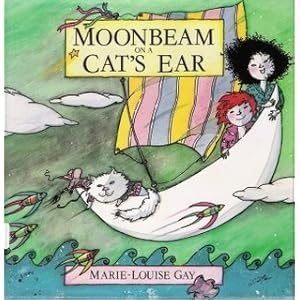
The 1987 winner: Moonbeam on a Cat's Ear

The future of libraries vs.  eBooks is a crazy, growing debate right now. It’s got me fired up (I’m working on more posts on that subject…).  While I suss that out,  here’s some news about a present-day happening in library land.

I’m on the CLA illustrator award committee and the 2011 shortlist has been officially announced.

Here they are:

Book of Big Brothers/ Illustrated by Luc Melanson (Groundwood Books)
Counting On Snow /Illustrated by Maxwell Newhouse (Tundra Books)
Fishing With Gubby / Illustrated by Kim La Fave (Harbour Publishing)
The Good Garden /Illustrated by Sylvie Daigneault (Kids Can Press)
I Know Here /Illustrated by Matt James (Groundwood Books)
Owls See Clearly At Night: A Michif Alphabet /Illustrated by Julie Flett (Simply Read Books)
Making the Moose Out of Life /Illustrated by Nicholas Oldhand (Kids Can Press)
Roslyn Rutabaga and the Biggest Hole on Earth! / Illustrated by Marie-Louise Gay (Groundwood Books)
Singing Away the Dark /Illustrated by Julie Morstad (Simply Read Books)
Spork/ Illustrated by Isabelle Arsenault ( Kids Can Press)

All of these books are amazing in their own way.  We boiled the long list down to this ten via conference call. It was probably one of the more interesting conversations I’ve had in a while. How often does anyone get to stick up and argue for something (with a little congenial  passion)  like this?

It doesn’t hurt that the calibre of the top ten, let alone the top twenty-eight books, is so amazing.

The next step is to decide the winner! To help me out, I’ve recruited some librarians who work with kids to go through the books with me. I’m really looking forward to these chats, since a) I love books and b) I love illustrations, illustrators, and the worlds they share with us. Opportunities like this make me glad I landed in the bibliothécaire profession.

Like anything on the list? Let me know in any way that pleases you.

library closed

From Stephen’s Lighthouse:

The movement to subscription models has some benefits:

1. You’re not locked in forever (or until it wears out) as a purchase can sometimes do.
2. You have the opportunity to offload the ‘keeping up-to-date factor’ on things that need replacing too often at high initial cost (software, servers, devices, etc,) or upgrade with annoying rapidity (like software and phone models).
3. You want to spread your investment out evenly in the annual budget over many years instead of investing in risky decisions that have higher upfront costs and commitments to servers vs browser access.
4. You want to reduce the risk of making a poor decision and committing to one choice that may be overtaken by innovation, trends, competition, time and events.
5. Access to bigger collections at less cost per user annually (like with the periodical experience)
6. Aggregated relationships with book publishers as has happened with periodical article access and standardization of e-formats and metadata and OpenURL compliance, etc.
7. Bulk influence on copyright and licensing of larger assemblages of content (a la Tasini, etc.)
8. Etc.[full blog post]

The last “etc.” could stand for the benefit of being subject to easily changed (by the vendor) terms of use of agreements (c.f. my earlier post on the HarperCollins kerfuffle, a kerfuffle, it should be observed, that could include a great many other vendors).

In fact, though thoroughly optimistic, Abrams’ list is also very one-sided. It’s not hard to imagine why – he is the VP Strategic Partnerships and Markets for Gale Cengage.  EBook sales are his business.  Read the rest of this entry »